
How to Use Edilex Procurement Templates
Introduction
Edilex procurement templates are designed to separate the selection process (the “RFX”) from the contract that governs what you are procuring (the “Contract”).
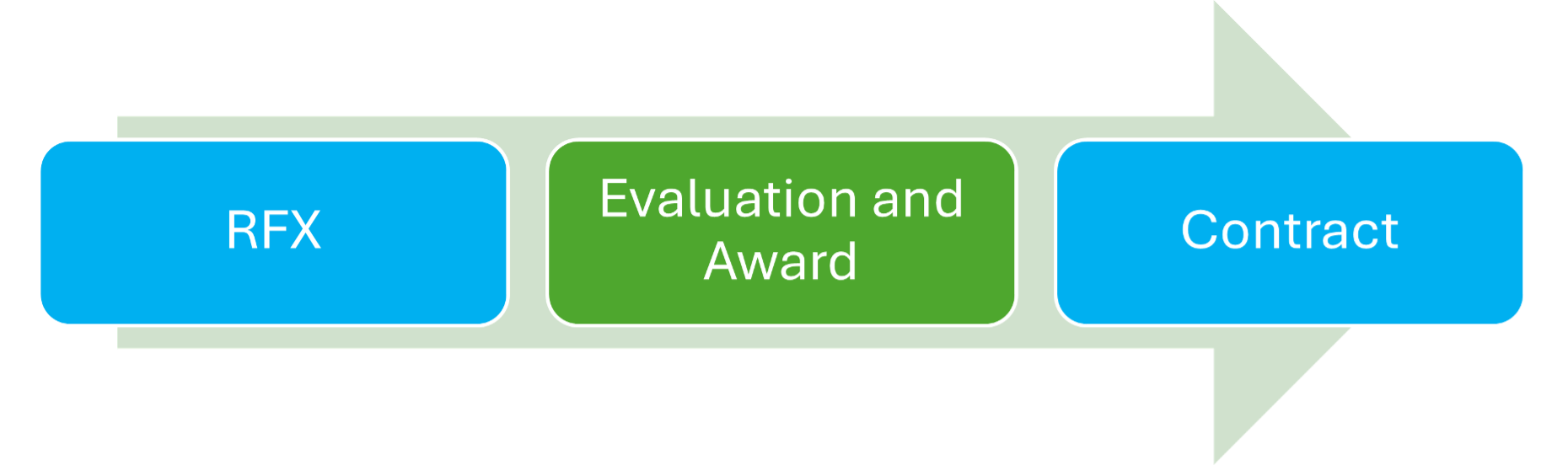
While all the templates are designed to be interoperable and seamless, there are strategic considerations to bear in mind when selecting the right RFX and contract. This guide will help you to select the right template for your procurement projects.
The RFX
The purpose of an RFX is to select a vendor. In Canadian law that selection process may give rise to a separate contract that exists prior to the contract that governs what you are procuring, and it is important to know whether the selection process you are using creates this contract. The process contract that arises during an RFX is called Contract A, which must be distinguished from the contract that governs the purchase itself, which is Contract B. When you create Contract A, the terms and conditions in the RFX govern the selection process not what you are buying.
All Edilex RFX templates follow the same structure, and each part of the document serves the same purpose in each template.
-
Part 1 – Introduction – This section highlights key parts of the RFX including what is being procured; the timelines for the procurement; and how and when to submit bids.
-
Part 2 – RFX Requirements – This section describes what is being procured.
-
Part 3 – Evaluation and Contract Finalization – This section outlines:
-
what bidders need to submit as part of a bid;
-
how bids will be evaluated; and
-
the process the organization will follow to finalize the Contract.
-
-
Part 4 – Rules of RFX Process – This section outlines the rules governing the RFX process.
-
Part 5 – Definitions – This section defines key terms used in the RFX.
-
Contract – The form of contract you attach to the RFX will depend on what you are procuring.
-
Forms – The RFX will contain forms that bidders must complete as part of the bid and include, at a minimum, a submission form and a price form.
Request for Tenders (RFT)
If you are drafting a RFT, please ensure the fixed fields are set to: RFT, Tender, Tenders, Tender Form, Tenderer and Tenderers.
-
When a bidder submits a binding tender, the RFT gives rise to Contract A.
-
The RFT should be used when you want to select a vendor based on the lowest price. It does allow bidder qualifications to be assessed on a pass/fail basis but does not facilitate qualitative evaluation.
-
The RFT is useful when the purchaser wants the assurance of a fixed bid or where materials will fluctuate in price during the bidding period.
-
It is commonly used and widely accepted in the construction industry.
-
In a RFT process, bids are legally irrevocable and that irrevocability can be secured with a bid bond.
Request for Proposals – Binding (RFP(b))
If you are drafting a RFP, please ensure the fixed fields are set to: RFP, Proposal, Proposals, Proposal Form, Proponent and Proponents.
-
Like the RFT, the RFP(b) also gives rise to a binding tender or Contract A.
-
The RFP(b) should be used where you require the assurance of a fixed price during the bidding period, but you also need to assess vendors qualitatively.
-
The RFP(b) is often used for technical services such as snow removal or other maintenance services.
-
One of the implied terms of Contract A is that the contract will be awarded as issued with the RFX – changes or post-award negotiations are not permitted. For this reason, the RFP(b) should only be used where the purchaser can issue a fully drafted contract to govern what is being procured and that contract will be acceptable to the industry.
-
In a binding RFP process, bids are legally irrevocable and can be secured with a bid bond, although the use of bonds is less common than with a RFT.
Request for Proposals – Non-Binding (RFP(nb))
If you are drafting a RFP, please ensure the fixed fields are set to: RFP, Proposal, Proposals, Proposal Form, Proponent and Proponents.
-
The non-binding RFP(nb) does not give rise to a pre-award contract – it is only used to select a vendor in a competitive, transparent manner. This means that bids are fully revocable up until the selected bidder signs the contract for the purchase.
-
The RFP(nb) is used to select a vendor where you want to evaluate both price and qualitative factors; however, it also allows you to negotiate with the selected bidder to either refine assumptions; improve the proposed approach or to align the contract with the appropriate commercial model or the correct allocation of commercial risk.
-
Non-binding RFPs are useful when procuring IT-related products and services but can be used for any purchase where you do not need security of price until you award and you want to negotiate with the selected bidder.
Request for Quotes (RFQ)
Please note that if you are drafting a Request for Quotes, Edilex offers a separate template just for this type of procurement.
-
The RFQ is a less formal selection process. It does not give rise to Contract A and is not appropriate for high value, complex procurements.
-
The RFQ is used to evaluate vendors based only on price for simple goods or services, for example, off-the-shelf licenses that can be purchased from a reseller market or one-time services with low risk. Some organizations use the RFQ for procurements below the trade treaty thresholds or for invitational procurements.
-
The RFQ is intended to be awarded using standard PO terms or a short form of agreement or based on standard vendor terms.
Summary
|
|
Request for Tenders |
Request for Proposals (Binding) |
Request for Proposals (Non-binding) |
Request for Quotes |
|---|---|---|---|---|
|
Does the RFX give rise to Contract A? |
Yes |
Yes |
No |
No |
|
Can you negotiate the contract? |
No |
No |
Yes |
No |
Comparison table of the models in the Public Procurement - Municipal Organizations repository
|
Term |
Definition |
Examples |
|---|---|---|
Goods (supplies)
|
For the purposes of our templates, this category refers to “simple” goods:
|
|
Technical goods
|
For the purposes of our templates, this category refers to more complex goods for which additional services are required:
|
|
Technical services
|
For the purposes of our templates, this category refers to services that require technical execution or application and are predominantly physical in nature.
|
|
Professional services
|
For the purposes of our templates, this category refers to services that are predominantly knowledge-based. Examples include services performed by licensed professionals (e.g., accountants, lawyers, surveyors); design professionals; advertising professionals; public relations firms; HR services (e.g., recruitment); management consulting services or other consulting services. These services generally involve analysis, research, drafting, design, creation, etc. and result in a work product that is supplied in a document or electronic format. |
|
Software licenses
|
For the purposes of our templates, this category refers to on-premises software, where the software is installed on the purchasing organization’s systems or servers and is then maintained, supported and updated by the software provider. |
Types of situations covered:
|
Software as a Service (SaaS)
|
For the purposes of our templates, this category refers to cloud computing solutions where software applications are hosted by a provider and delivered to users over the internet, rather than being installed and run on the user’s own computers or servers. |
Types of situations covered:
|